Own Space and Time
“Play faster!” Coaches talk about it constantly. Speed of play matters. But playing fast isn’t about running harder or taking more touches. It’s about owning two things that separate good players from great ones: space and time.
You earn both long before the ball reaches your foot.
First Touch Dictates Everything
Your first touch either gives you space or removes it. It buys you time or steals it from you.
In my first blog, I talked about how the first touch makes the player. That continues here: you can’t own space or time if your first touch isn’t intentional. A clean, purposeful touch sets up the rest of the sequence—passing, dribbling, or combining. A sloppy touch forces extra steps, panic, and pressure.
A great first touch isn’t about technique alone—it's about preparation. The best players already know what they want to do before the ball arrives because they’ve scanned the field.
Rondos: Pressure, Awareness, Tempo
Rondos are the most efficient tool in player development. You’re forced to think quickly, move constantly, and support the ball. The moment you stand still, you’re done.
Offensively, rondos teach:
angle creation
quick one- and two-touch passing
clean receiving shape
constant scanning and anticipation
Defensively, they teach:
pressing with purpose
closing angles and lanes
working together instead of chasing
Rondos compress the game into its purest form: make decisions faster than the pressure can reach you.
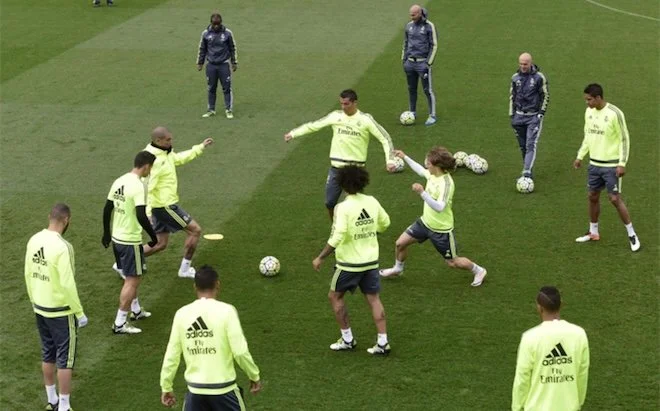
Real Madrid Rondo (Ronaldo, Modric, Benzema, Marcello)
Triangles and Diamonds: Structure That Creates Options
Soccer is geometry disguised as a sport.
Triangles and diamonds are the shapes that make the game work.
Why? Because they naturally create:
two to three passing options
predictable support angles
space to play through and around pressure
balance between width, depth, and central support
Offensively, these shapes allow players to break defensive lines with simplicity.
Defensively, they help limit gaps, shift together, and guide pressure.
Small spaces reveal how powerful these shapes really are.
One- and Two-Touch: The Weapon of Modern Play
Playing fast is a byproduct of:
scanning
smart positioning
clean first touch
decisive thinking
One- and two-touch soccer forces defenders to constantly adjust. When they shift, they leave cracks. When cracks appear, you break lines.
This is how you progress through the defensive, middle, and attacking thirds with tempo and purpose.
Dribbling With Purpose
Dribbling matters—but not for highlight reels.
It’s a tool to move defenders and create new passing lanes.
A small touch forward or sideways forces a defender to adjust.
Once they move, someone else becomes open.
Good dribblers fix defenders in place.
Great dribblers shift them, then release the ball at the right moment.
Scanning: Seeing the Game Before It Happens
Owning time requires scanning—early, often, and with intent. Players who scan before receiving already know:
where pressure is coming from
where teammates are moving
where the open space is
what their next action should be
That’s why they can play one- and two-touch with confidence.
They’ve already solved the problem.
Play Within Your Skill Set (and Expand It)
Not every moment demands a killer pass.
Smart players choose actions that match:
the moment
the pressure
their technical ability
Consistency first. Creativity second.
When fundamentals become automatic, the game opens up.
Own Space. Own Time. Control the Game.
Here’s the truth most players never think about:
A top-level player has the ball for less than 3% of a match.
In a 90-minute game, that’s only 1.5 to 2 minutes of actual possession.
The rest—97% of the game—is about:
positioning
anticipation
scanning
movement
supporting teammates
shaping the next sequence
That’s why small spaces matter.
That’s why rondos matter.
That’s why owning space and time is the real separator.
Players who master these habits make the game look easy.
They dictate. Everyone else reacts.